
What it is:
AI-assisted global payroll management, where software handles calculations, compliance tracking, and error detection across multiple countries while humans oversee decisions.
Why it matters:
What to compare:
Bottom line:
AI makes global payroll faster and more accurate, but it doesn’t remove your liability. Use it to handle volume, keep humans involved for decisions, and stay compliant as you grow internationally.
If you have employees or contractors in more than one country, you already know this feeling. Every country runs on its own tax rules, work laws, reporting deadlines, and contribution rates. What's standard in the US is completely different in Pakistan, India, or South Africa.
Missing a single regulatory update can mean fines, back payments, and legal exposure you didn't see coming. And the updates don't stop. Governments change minimum wages, adjust tax bands, and introduce new filing requirements, sometimes mid-year, sometimes with little warning.
Most SME founders don't have a dedicated payroll compliance team watching every country's regulations around the clock. You're running a business. You can't also be a global tax expert in 10 jurisdictions simultaneously. That's exactly where AI starts to earn its place.
Speed and accuracy on routine calculations. AI-powered payroll tools apply the right tax rates, local deductions, and mandatory contributions for each employee's country automatically. No manual formula work. No "I forgot to update the rate last quarter" mistakes that only surface at audit time.
The difference in speed is real. What used to take a payroll team several days to process manually, checking rates, applying rules, validating outputs, now runs in minutes. For a growing business managing staff across multiple countries, that time saving compounds quickly.
Catching errors before payday. AI spots unusual patterns across your payroll data, duplicate payments, wrong tax classifications, missed deductions, sudden changes in someone's take-home pay. It flags these before the money goes out, not after. That's a fundamentally different relationship with payroll errors than most small businesses are used to.
Traditional processes catch mistakes after they've already hit someone's bank account. Then you're dealing with corrections, amended filings, and unhappy employees. AI moves that catch earlier in the process, where fixing it is cheap and simple.
Tracking regulatory changes fast. Tax laws change constantly across every country you operate in. AI monitors official government sources and regulatory databases continuously, updating your payroll rules within days of a change being published. The old way, waiting for a compliance newsletter or hoping your accountant noticed, could leave you running on outdated rules for weeks.
That gap matters. Running payroll on last month's tax rates in a country that just updated them isn't just an inconvenience. It's a liability.
This is where a lot of vendors oversell their tools, and where SME founders sometimes get caught out. AI is not a compliance lawyer. It does not understand the nuance behind the rules it's applying.
It can't tell you whether your long-term freelancer in the Netherlands has crossed the legal threshold into employee territory. It can't decide how to handle the tax situation for a team member who relocated from Germany to Singapore halfway through your financial year. It can't interpret a new piece of employment legislation and tell you what it means for your specific contractor arrangements.
These situations need human judgment, someone who understands local employment law and how it applies to your specific business setup. AI surfaces the issue. A human makes the call. That distinction matters enormously when the consequences of getting it wrong are real.
The liability question nobody talks about enough. When AI makes a payroll error, you're still the one who's liable. Not the software. Not the platform. You. Your business signed off on that payroll run, and tax authorities don't accept "the system got it wrong" as a defence.
That's why human oversight on final payroll approvals, particularly across multiple countries, is non-negotiable. AI reduces the chances of something going wrong. It doesn't eliminate them.
About a third of employers make payroll errors every year. Many happen not because the software failed, but because someone trusted it completely and skipped the human check that would have caught the edge case.
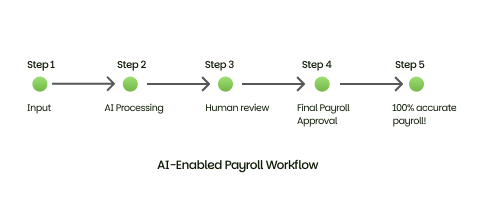
Here's something worth knowing before you start shopping for tools. Most payroll platforms that call themselves "AI-powered" are actually running basic automation, pre-programmed rules that execute the same calculations every time, the same way, without learning or adapting.
Real AI is different. It learns from patterns across thousands of payroll runs. It can read a messy, non-standard document and still extract the right information. It improves its accuracy over time. Basic automation breaks the moment something doesn't fit the template it was built for.
The practical test is simple. Ask any vendor two questions: what's your average error rate across multi-country payroll runs? And how quickly do you implement regulatory changes after they're published? Those two metrics tell you more about a platform's actual capability than any sales deck ever will.
If they can't answer clearly, that's your answer.
Here's a scenario that comes up constantly. You have 60 employees in the US, three contractors in India, and you just hired your first full-time employee in Pakistan. The US payroll runs smoothly because you know that system. But offshore? Different tax structures, different filing deadlines, different rules around termination and benefits.
Those three people outside the US require the same compliance rigour as your entire domestic team. That's the hard reality of global hiring that catches founders off guard. The "long tail" of small headcounts in new markets is where compliance problems quietly accumulate.
AI helps you manage that complexity without hiring in-country compliance experts for every market you enter. Good platforms handle the monitoring, updating, and error-flagging so your team isn't buried in regulatory research. See how our global payroll services work.
But, and this is worth repeating, for first-time setups in a new country, unusual contractor arrangements, equity compensation, or anything involving employee termination, always get a human to review the output before it goes through.

Most SME founders running global payroll are somewhere on a spectrum. On one end: entirely manual, spreadsheet-based, chasing documents over email. On the other end: a fully integrated platform with real-time compliance monitoring across every jurisdiction.
Most businesses sit somewhere in the middle, using a payroll tool, but one that isn't actually keeping pace with regulatory changes or flagging errors proactively.
A few questions worth asking yourself right now:
If those questionare uncomfortable, that's useful information. Talk to us about where your setup has gaps.
AI does the heavy lifting on volume, speed, and monitoring. Your people handle the judgement calls, legal decisions, and anything that sits in a grey area. Neither works as well alone.
The founders who get global payroll right aren't the ones who found the perfect software. They're the ones who built the right combination, solid AI-driven tools doing the routine work, experienced humans reviewing what matters, and clear processes for when something unusual comes up.
That's not complicated. But it does require being honest about what your current setup actually does, and where the gaps are.
AI has genuinely changed global payroll compliance. It's faster, more accurate, and far better at tracking regulatory changes than any small team managing it manually ever could be.
But it's a tool, not a complete solution on its own. The liability stays with you. The judgement calls stay with humans. The smart approach uses AI for what it's good at and keeps experienced people in the loop for everything else.
If you're hiring across borders and want to get compliance right without building an in-house payroll department, the right support makes a significant difference. Visit our website to see how we work with SMEs navigating exactly this, or contact us here and let's talk through your specific situation.




.svg.png)