

What it is:
A practical breakdown of how AI and offshore hiring are reshaping recruitment and how to combine both without breaking your hiring process.
Why it matters:
Hiring isn’t just getting harder, it’s getting structurally different. Companies that rely on manual, local-only hiring are slower, more expensive, and less competitive than those using AI and global talent strategically.
What to know:
Bottom line:
AI and offshore hiring aren’t optional advantages anymore, they’re the new baseline. The companies winning in 2026 aren’t replacing humans with AI; they’re using AI to move faster and global talent to scale smarter, without losing human judgment where it matters most.
You've probably noticed it by now. The hiring process feels different. Slower. More expensive. And somehow, more complicated, even as everyone tells you technology is supposed to be making things easier.
Here's what's actually happening: AI has fundamentally changed how smart companies build teams. And if you're still doing it the old way, posting a job, waiting for applications, screening resumes manually, you're already behind. But this isn't a story about robots replacing people. It's a story about which parts of hiring can be automated, which parts still need a human, and how the businesses that combine both are winning.
The companies growing fastest in 2026 aren't choosing between AI and people. They're using AI to find candidates faster and offshore talent to do the work their local budgets can't sustain. If you're a founder or operator in a high-cost market like the US, this shift hits harder. You're under pressure to scale headcount, move faster, and stay lean all at the same time. And traditional hiring models weren’t built for that reality.
Let's start with the cost. Hiring locally in the US is expensive and getting more expensive every year. A full-time finance or operations hire in the US typically costs $80,000 to $140,000+ annually once you factor in salary, benefits, healthcare, and overhead.
Offshore hiring changes that math completely. Businesses consistently save 50–70% per role when hiring offshore for both technical and non-technical roles, even AI engineers, without sacrificing quality. That's not a small difference. That's the difference between hiring one person locally and hiring two people offshore for the same budget. For a growing business, that kind of leverage matters.
Now layer in AI. Companies using AI in their hiring process are reporting 30% reductions in cost-per-hire and up to 50% faster time-to-hire. Screening 200 applications that would take a human 5–15 hours? AI does it in minutes.
The result: when you combine AI-assisted sourcing with offshore talent, you get a faster, leaner hiring machine that your competitors running purely local, manual processes simply can't match.
For growing companies, this isn’t just about saving money. It’s about buying back runway and increasing execution capacity. The difference between one hire and two for the same budget isn’t incremental; it changes how fast your company can build, test, and grow.
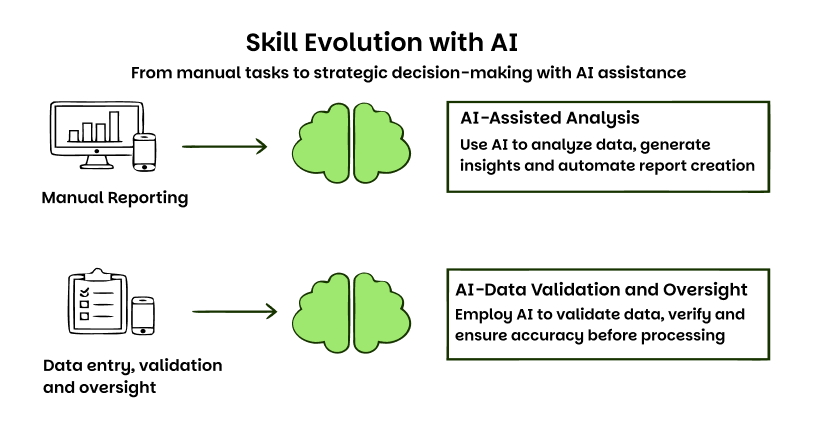
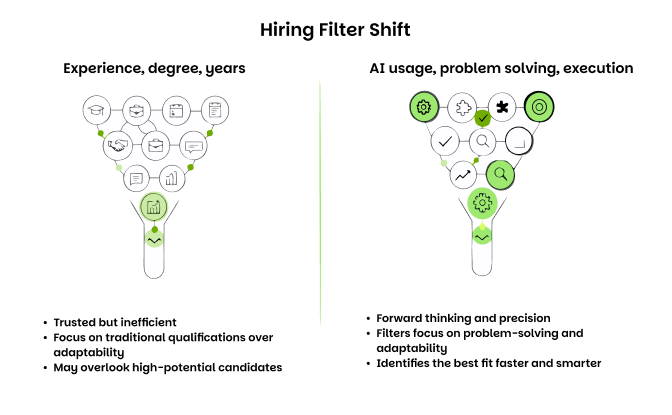
Before you hand your entire hiring process to an algorithm, it's worth being clear about where AI helps and where it actively hurts. Most teams make the same mistake here: they try to use AI to replace decision-making instead of accelerating it. That’s where hiring quality starts to break. The goal isn’t to remove humans from the process. It’s to remove the parts humans are bad at, so they can focus on the parts that actually require judgment. AI is genuinely excellent at high-volume, pattern-matching work. AI-powered screening tools reduce resume review time by up to 75%. It can scan job boards at scale, flag candidates who match your criteria, schedule interviews automatically, and keep your pipeline moving without anyone lifting a finger.
But here’s the part most vendors don’t advertise: AI consistently fails at anything that requires judgment, context or reading between the lines.
A candidate who changed industries twice but has exactly the transferable skills you need? An algorithm will likely filter them out. Someone whose resume doesn't match your keyword list but who would be perfect for your team's culture? Gone. And critically, only 26% of job applicants trust AI to evaluate them fairly, which means your best candidates may disengage the moment they realize they're talking to a bot.
The fix isn't to avoid AI. It's to use AI where it excels and keep humans, in every part of the process that requires actual judgment. The risk isn’t just missing good candidates. It’s building a hiring process that unintentionally filters out exactly the kind of people who thrive in fast-moving, ambiguous environments, which is what most growing companies actually need.
There's a less obvious benefit to building an offshore team that most business owners miss entirely: time zone coverage. When your North American team signs off at 6 pm, your offshore team in South Asia is starting their morning. That means candidate outreach continues overnight. Automation happens while you sleep.
This isn't about replacing your team. It's about extending your reach into hours and markets your onshore staff simply can't cover, without the overhead of building a second local team. Over time, this creates something most teams don’t have: continuous pipeline momentum. While others are hiring in a straight line, your process keeps moving in parallel, across time zones, without adding overhead.
Here's where a lot of companies stumble. They find great offshore talent, make a hire, and then realize they have no idea how to legally employ someone in another country.
Different payroll laws. Different tax obligations. Different termination rules. In South Asia alone, the regulatory landscape varies significantly by country and getting it wrong exposes your business to real legal and financial risk.
This is exactly what an Employer of Record (EOR) solves. Instead of setting up a local legal entity in every country you hire from, which can cost tens of thousands of dollars and take months, an EOR becomes the legal employer on your behalf. They handle contracts, payroll, benefits compliance, and local labor law, while your offshore employee works directly for you in practice.
About 50% of organizations plan to expand their offshore footprint and the ones doing it right are using EOR infrastructure to remove the compliance friction entirely. This is the layer that makes global hiring actually scalable. Without it, offshore hiring adds risk. With it, it becomes repeatable infrastructure.
The bottom line: the cost and legal complexity of hiring offshore doesn't have to fall on your shoulders. The right EOR partner absorbs that entirely.
Here are the most common mistakes founders usually make while building teams with AI:
If you're still relying on manual processes and local-only hiring, you're not just moving slower, you're limiting how your company can scale. The opportunity isn’t just to hire cheaper or faster. It’s to design a hiring system that:
The founders succeeding aren’t simply putting people in seats. They’re building teams designed for speed, efficiency and scale.
AI didn’t break hiring, it exposed what was already inefficient. The real shift isn’t about choosing between automation and people, or local vs offshore. It’s about designing a system where each does what it’s actually good at.
The companies getting this right aren’t just hiring faster or cheaper. They’re building hiring processes that are deliberate, compliant, and resilient at scale. Everyone else is just adding tools on top of a system that no longer works.





.svg.png)