

What it is:
Why it matters:
What to compare:
Bottom line:
Healthcare is table stakes. Strong public systems need supplementary coverage for speed. Weak systems require robust employer plans. Comprehensive IPD+OPD is key to competing for and keeping top global talent.
When you're building a global team, healthcare for employees isn't just another checkbox on your benefits list. It's one of the most critical factors that determine whether top talent accepts your offer, stays with your company or jumps to a competitor. In markets where employer-provided healthcare isn't guaranteed, offering comprehensive medical coverage, especially IPD (Inpatient Department) and OPD (Outpatient Department) coverage, can be the difference between building a stable, high-performing team and constantly battling turnover.
But here's the challenge: healthcare for employees in remote locations is complex. Every country has different healthcare systems, mandatory benefits, insurance markets and expectations. What's considered "basic" coverage in one market might be premium in another. And if you're building a cross-border team, you need to know what's typically included, what's not and how to structure benefits that actually matter to your employees.
Let's start with the reality: healthcare is personal. When an employee gets sick, when their child needs medical care, when a family member requires surgery, these aren't abstract HR policy questions. They're life-changing moments. And if your benefits don't support your employees through those moments, they'll find an employer who does.
Healthcare Drives Retention
Turnover in global teams is costly. According to Gallup, for a new employee it takes around 12 months to become fully productive, and, according to SHRM, replacing them may cost 50-200% of the employee's annual salary. For employees, healthcare is one of the top priorities out of all benefits, often more important than salary increments. Why? Because quality healthcare is expensive and hard to access without employer-sponsored insurance.
Healthcare Impacts Productivity
Employees without health insurance delay medical care. They work while sick instead of seeing a doctor. They skip preventive checkups that could catch serious conditions early. The result? More sick days, lower productivity and medical emergencies that could have been avoided.
Conversely, employees with strong healthcare coverage use preventive care (annual checkups, screenings, vaccinations), catch health issues early and recover faster from illnesses. They're more productive, more engaged and less likely to take extended medical leave.
Healthcare Is a Competitive Advantage in Recruiting
When you're hiring in a global talent market, you're competing with other international employers, local enterprises and government roles, all of which offer varying levels of healthcare. If your offer includes comprehensive IPD and OPD coverage, dental, vision and dependent coverage, you're immediately more attractive than competitors offering statutory minimums.
Top talent has options. The developers, designers and marketers you want to hire are evaluating multiple offers. Healthcare benefits can tip the scale.
For more on how to structure competitive benefits packages when hiring globally, see our guide on global workforce solutions.
Understanding which countries have robust healthcare systems helps you tailor benefits appropriately. Employees in countries with strong public healthcare still value employer-sponsored insurance, but their needs differ from employees in countries where public healthcare is weak or nonexistent.
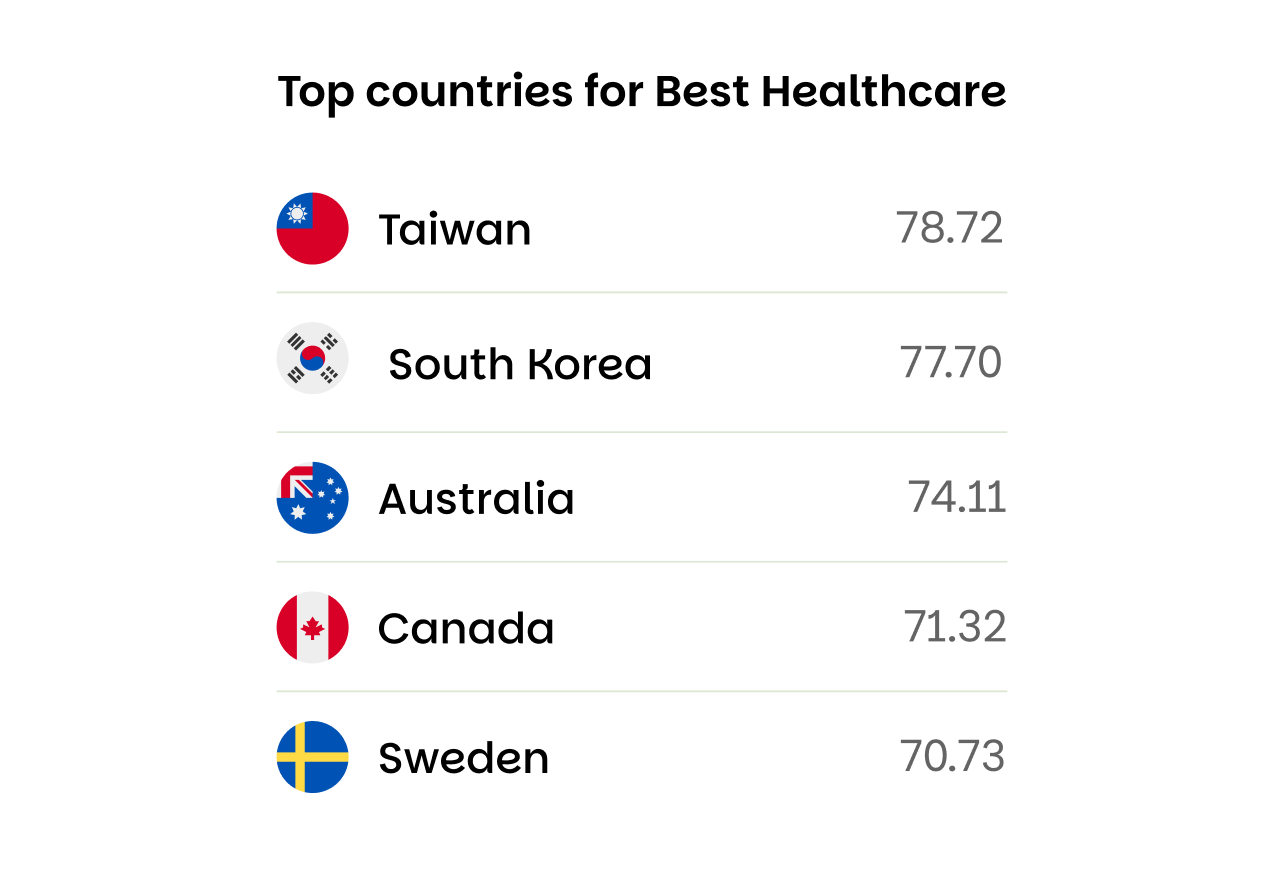
Top Healthcare Systems Globally (2026 Rankings)
According to the 2026 CEOWORLD Health Care Index, Taiwan ranks as the country with the best healthcare system in the world with a score of 78.72, followed by South Korea (77.7), Australia (74.11), and Canada (71.32).
What This Means for Employers:
In countries with strong public healthcare, employees still value employer-sponsored insurance for:
In developing countries with weak or nonexistent public healthcare, employer-sponsored insurance is essential, not supplementary. Without it, employees face catastrophic medical expenses or forgo care entirely.
Even if you choose an EOR or you want to provide the coverage yourself. Here's what to evaluate in the coverage:
1. IPD + OPD vs. IPD-Only
Ask explicitly: "Does your health insurance cover outpatient care (doctor visits, diagnostics, prescriptions) or only inpatient care (hospitalization)?" If it's IPD-only, your employees will pay out-of-pocket for 90% of their healthcare needs.
2. Coverage Caps and Limits
Some insurance plans have annual caps. If an employee needs expensive surgery or long-term treatment, they could hit the cap and face catastrophic expenses. Look for plans with high or no caps.
3. Co-Pays and Out-of-Pocket Costs
Co-pays (the percentage of costs employees pay) vary. For many countries employers themselves pay for the insurance coverage. The employee only contributes to the EOBI contributions.
4. Dependent Coverage
Can employees add their spouse and children? At what cost? In developing markets, dependent coverage is a major retention driver.
5. Pre-Existing Conditions
Are chronic conditions covered? Is there a waiting period? Employees with diabetes, hypertension or asthma need coverage that actually works.
6. Network Size
Does the insurance work at top hospitals in the employee's city? A large network means employees can access care where they want. A narrow network forces them to travel or pay out-of-pocket.
7. Maternity and Mental Health
Are prenatal care, delivery and postnatal care covered? Is therapy or counseling included? These benefits are increasingly important for attracting diverse talent.
8. Transparency on Costs
Hidden coverage costs can blow up your budget. Get a full breakdown upfront.
Most employers handle statutory benefits, the legal minimums required by a country's labor law. But statutory benefits are rarely enough to attract and retain top talent. Here's what most employer policies don't cover and why it creates a gap in your benefits package:
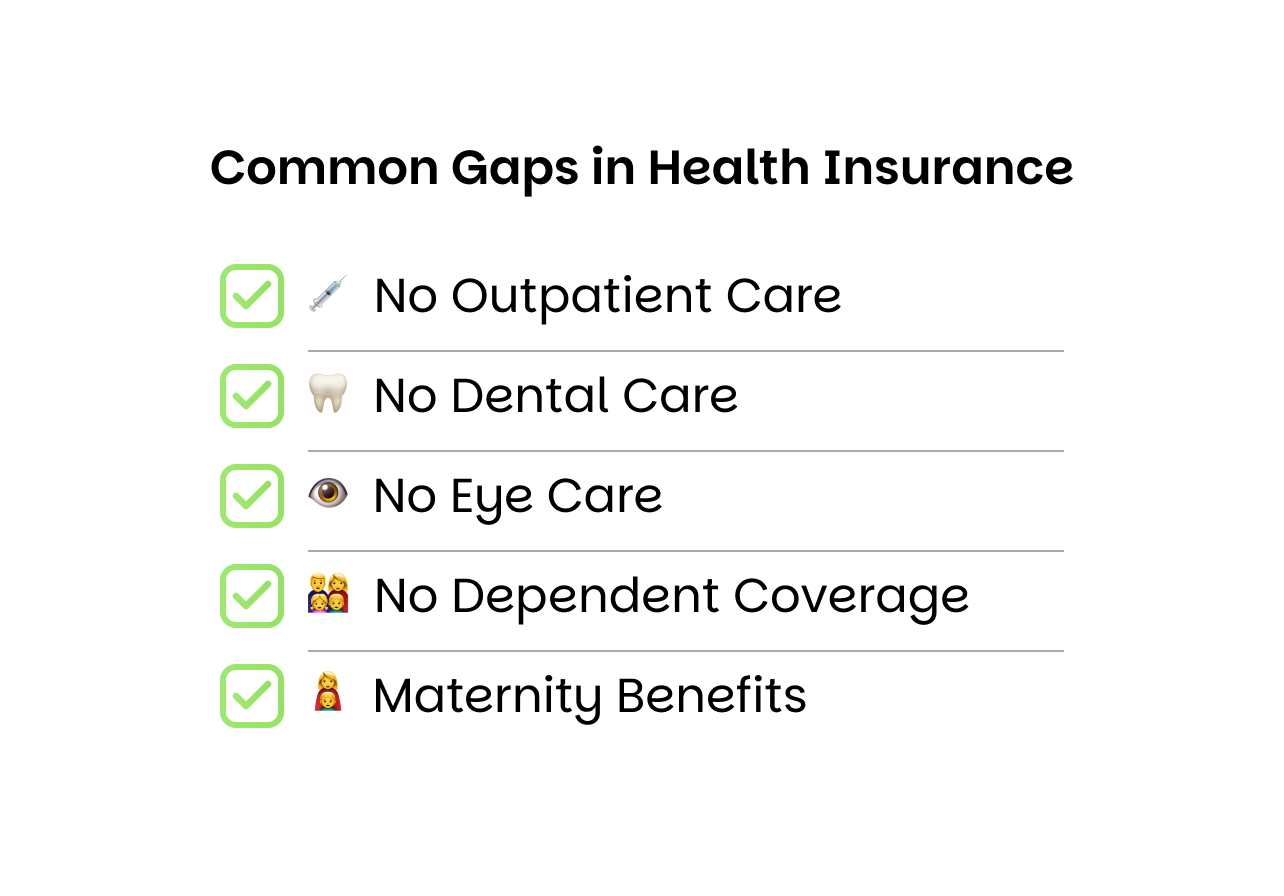
1. Comprehensive OPD (Outpatient) Coverage
Many companies offer IPD coverage (hospitalization, surgeries) but exclude or limit OPD coverage (doctor visits, diagnostics, prescriptions). The problem? Employees use OPD far more frequently than IPD. If your insurance only covers hospitalization, employees pay out-of-pocket for routine care, which erodes the perceived value of your benefits.
2. Dental and Vision Care
Dental and vision coverage are often excluded from basic insurance plans. Yet these are highly valued benefits. Dental care is expensive (root canals, crowns, braces) and vision care is essential for employees working on screens all day. Excluding these benefits makes your package feel incomplete.
3. Mental Health Support
Mental health coverage is rare in emerging markets, even though demand is rising. Therapy, counseling and psychiatric care are expensive and stigmatized. Offering mental health support (either through insurance or wellness programs) signals that you care about your employees' holistic wellbeing.
4. Dependent Coverage (Spouse and Children)
Many employers cover the employee only, excluding dependents. Offering dependent coverage (spouse, children, sometimes parents) dramatically increases the value of your benefits and improves retention.
5. Maternity Benefits
Statutory maternity leave and benefits vary by country, but many insurance plans exclude prenatal care, delivery costs, or postnatal care. Comprehensive maternity coverage is critical for attracting and retaining employees.
The Bottom Line: If your policy only covers statutory minimums, your benefits package is incomplete. You'll struggle to compete for top talent and retention will suffer. That's why East Consulting goes beyond statutory requirements and offers comprehensive IPD + OPD coverage and dependent options in all markets we operate in.
Beyond choosing the right way to hire an employee, here are best practices for managing healthcare benefits for distributed teams:
1. Communicate Benefits Clearly
Employees need to understand what's covered. Create simple, one-page summaries of healthcare benefits in plain language (not insurance jargon).
2. Provide Onboarding Support
When new employees join, walk them through how to use their health insurance. How do they find in-network hospitals? How do they file claims? What documents do they need? Onboarding support reduces confusion and ensures employees actually use their benefits.
3. Offer Mental Health and Wellness Programs
Even if your insurance provider doesn't include mental health coverage, you can supplement with wellness programs: access to therapy apps (BetterHelp, Talkspace), mental health days, mindfulness workshops, or gym stipends. These programs are low-cost but high-impact.
4. Survey Employees on Benefits Satisfaction
Once a year, ask employees: "Are you satisfied with your healthcare benefits? What's missing?" Use this feedback to negotiate better coverage with your insurance provider or switch providers if needed.
5. Plan for Medical Emergencies
Have a protocol for medical emergencies. If an employee is hospitalized, who do they contact? How do you ensure bills get paid? Clear protocols reduce stress and show you care.
If you're serious about building a world-class remote team across borders or the US, healthcare isn't optional. It's the foundation of your employee value proposition. Comprehensive IPD + OPD coverage signals that you care about your employees' wellbeing, that you're willing to invest in them and that you're a stable, professional employer worth staying with for years.
At East Consulting, we've built our EOR services around this principle. We provide comprehensive healthcare coverage in all markets we operate in because we know it drives retention, productivity and your ability to compete for top talent. When candidates are evaluating offers, when employees are deciding whether to stay or leave, healthcare is one of the deciding factors.
Don't settle for EOR providers that offer statutory minimums and expect you to compete for talent with subpar benefits. Choose a partner who understands that healthcare is non-negotiable and who backs that up with real, comprehensive coverage.
If you're ready to build a remote team with benefits that actually matter, contact East Consulting to learn how we can help you hire compliantly, manage benefits seamlessly, and retain the talent you need to grow.






.svg.png)