

What it is: Third-party companies that manage some or all HR functions, payroll, benefits, compliance and employee relations, so you don’t have to.
Why it matters: HR mistakes may cost small businesses an average of $7,000 per employee annually in penalties, turnover and lost productivity. Outsourcing shifts that risk to experts.
What to compare:
Red flags:
Bottom line: Outsourced HR costs $50–$1,500+ per employee monthly, depending on services, but preventing a single lawsuit or compliance violation often covers years of service.
You're running an SME or a startup and HR tasks are eating up hours you don't have. Payroll errors, compliance headaches and employee questions are piling up. Outsourced HR services promise relief, but you're wondering if they're worth the investment.
Outsourced HR services transfer your people management tasks to external specialists. Instead of hiring a full-time HR person at $60,000-$85,000 annually, you pay a fraction of that for professional expertise.
These services range from basic payroll processing to comprehensive employment management. Some companies outsource everything, others just the complex compliance stuff they can't handle internally.
The model makes particular sense for businesses with 5-50 employees. You're too small for a full HR department but too big to wing it with spreadsheets and guesswork.
Professional Employer Organizations (PEOs) become your co-employer. They handle payroll, benefits, compliance, and risk management while you maintain day-to-day control. Your employees technically work for both you and the PEO.
Administrative Services Organizations (ASOs) provide HR services without the co-employment relationship. You retain all legal employer responsibilities while they handle administrative tasks. More control, but also more liability.
Human Resource Outsourcing (HRO) providers offer à la carte services. Need just payroll? Done. Want recruitment help? They've got it. You pick and choose based on your gaps and budget.
Employer of Record (EOR) providers act as the legal employer on your behalf. They hire employees through their local entities, manage payroll, taxes, benefits and ensure compliance with local labor laws, while you retain full control over the employee’s day-to-day work. Unlike PEOs, EORs do not require you to set up a local entity, making them ideal for international hiring, rapid market entry and managing distributed global teams with minimal risk.
When companies hire offshore through an Employer of Record (EOR), the pricing structure differs from traditional local HR outsourcing. EOR providers handle payroll, taxes, compliance, benefits and statutory obligations in the target country, allowing your business to hire employees internationally without establishing a legal entity.
Typical pricing in 2026 varies depending on country, industry and employee level. Entry-level offshore employees may cost $199–$400 per employee per month, while roles requiring specialized skills or in highly regulated markets can range from $500–$1,500+ per employee per month.
This cost variation reflects factors such as:
The EOR market has exploded in recent years. The global EOR market is currently worth around $6.82 billion and is expected to reach $15.98 billion by 2034. This growth reflects a fundamental shift in how companies build teams.
Remote work demolished geographic barriers to hiring. Why limit yourself to local talent when you can hire the best person anywhere? But international employment comes with staggering complexity, different labor laws, tax systems, statutory benefits and termination requirements in every country.
Asia-Pacific is the fastest-growing region, with an expected 10% CAGR through 2034. From 2022 to 2024, there has been a 48% increase in businesses using EOR platforms in Latin America. Small businesses are going global faster than ever before.
For most small businesses, EOR services are the only practical path to international hiring.
Compliance support covers federal and state employment law updates, required poster updates, policy reviews and guidance on classification issues. For international teams, this extends to country-specific labor codes, mandatory contracts and statutory compliance.
Benefits administration means managing health insurance enrollment, 401(k) coordination, COBRA notifications and open enrollment. EOR providers handle statutory benefits like social insurance, pension contributions and mandatory leave programs in each country.
Employee relations support includes termination guidance, performance management coaching, workplace investigation assistance and conflict resolution. For EOR services, this includes navigating country-specific termination procedures that can be wildly different from US at-will employment.
An EOR becomes the legal employer for workers in countries where you don't have a registered entity. They handle all employment compliance, payroll, taxes and benefits while you manage the day-to-day work and performance.
This model solves a fundamental problem: you want to hire someone in Pakistan, but you don't have a Pakistani company. Setting one up costs thousands of dollars, takes months and a local partner. The EOR already has the legal entity and infrastructure.
EORs navigate complex international employment laws you'd never master yourself. France requires specific termination procedures and works councils. Germany mandates extensive employee rights and notice periods. Brazil has 13th-month salary obligations. EORs handle all of it.
The worker gets local employment protections, statutory benefits and contracts in their language. You get the talent without the legal headaches or entity costs. It's a win-win that's reshaping how small businesses compete globally.
Both serve different needs. PEOs work within your home country, pooling employees to access better benefits and reduce administrative burden.
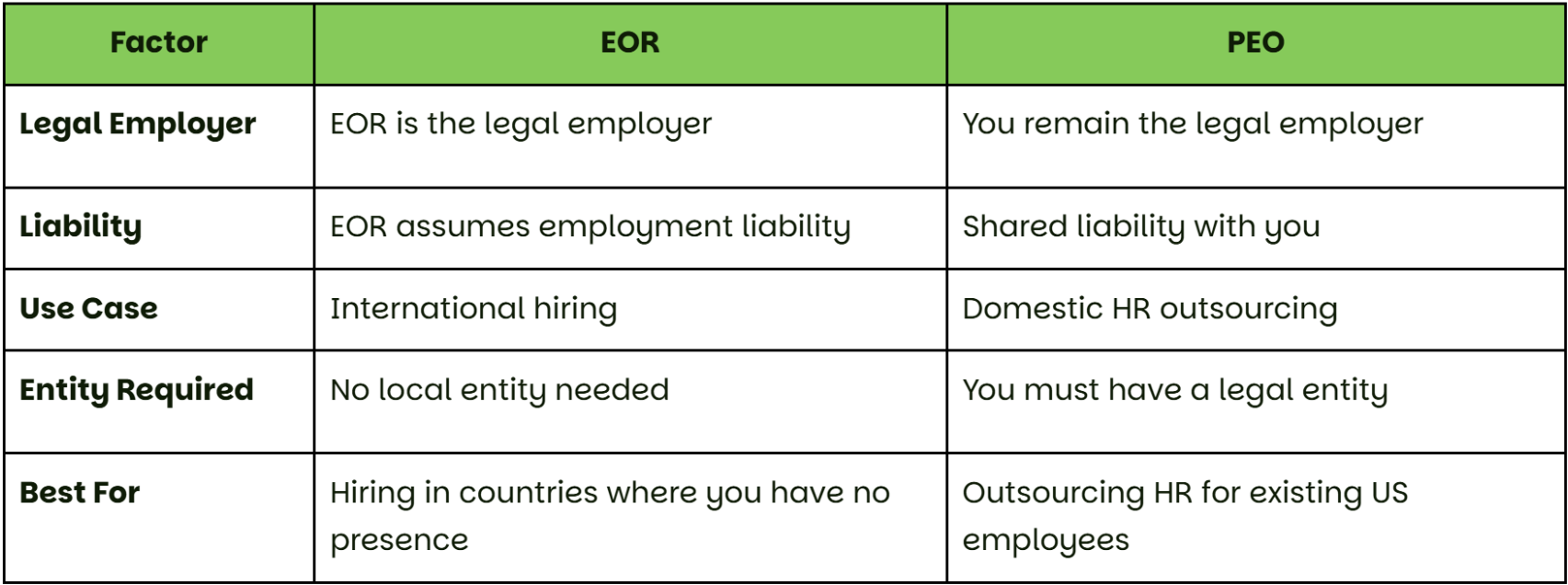
EORs work internationally, providing the legal entity you don't have in foreign countries. They're essential for cross-border hiring, while PEOs are domestic efficiency plays.
Pricing reflects this difference. PEOs can be cheaper per employee because they operate in familiar regulatory environments and leverage economies of scale. EOR pricing includes the complexity and risk of international compliance.
You might use both simultaneously a PEO for your US team and an EOR for your contractors in Pakistan, India and Egypt. Many companies do exactly this as they scale globally.
EOR providers typically include the following in their monthly fees:
These services convert complex legal obligations into predictable monthly fees while you retain control over day-to-day work.
When selecting an EOR:
Many companies combine EOR operational support with a fractional HR director:
Budgeting for these hidden costs ensures no surprises during expansion.
Outsource when:
Keep in-house if:
EOR services let companies avoid entity setup delays, which can take months and cost tens of thousands.

Picking based solely on price backfires fast. Always compare quality and retention rates. Expensive doesn’t always mean the best and cheapest doesn’t always mean the worst. Pricing depends on multiple factors; scope of service, your needs, number of countries covered, etc.
Not understanding country coverage for EOR services leads to problems. A provider with 150 countries sounds impressive until you realize they're weak in the three countries where you want to hire.
Failing to check compliance track records is dangerous. Ask potential providers about their error rate on payroll taxes and how they handle mistakes. Who pays penalties, you or them? This matters even more internationally.
Underestimating transition time and effort creates chaos. Moving payroll and benefits to a new provider takes time both domestically and internationally. Plan accordingly and communicate clearly with your employees.
Ignoring employee experience is short-sighted. Your team will interact with this provider for onboarding, benefits questions and payroll issues. Clunky systems and poor support frustrate employees and reflect badly on you.
Calculate time savings first. If you're spending 15 hours weekly on HR tasks at a $75 hourly rate, that's $58,500 annually. Outsourcing at $30,000 annually nets $28,500 in recovered time.
Factor in error reduction. Total annual compliance risk exposure often lands in the $5K–$10K range for SMBs. International penalties, often significantly higher depending on jurisdiction. Outsourcing eliminates most of this.
Consider recruitment and retention improvements. Professional onboarding and benefits administration reduce turnover. If replacing an employee costs 50-200% of salary, better retention pays for outsourcing quickly.
Don't forget peace of mind and opportunity cost. Having experts handling compliance while you focus on growing the business has real value. The ability to hire globally without legal risk opens massive market opportunities.
What's your experience with companies my size in my industry and target countries? Generic providers miss industry-specific requirements and country-specific nuances that could cost you big later.
What's your actual presence in my target countries, legal entities or partner networks? Direct entities mean better control and support. Partner networks can have quality issues.
How do you handle payroll errors and who pays resulting penalties? The right answer is they fix errors immediately at their cost and cover any penalties from their mistakes. Get this in writing.
What's your client retention rate and average client tenure? High churn signals problems with service quality or hidden issues.
Can I speak with three current clients similar to my business hiring in the same countries? Any hesitation here is a massive red flag. Great providers happily connect you with happy customers.
What's included in the base price versus add-on services? Get a complete breakdown to avoid surprise fees six months in. Ask specifically about FX fees, equipment provisioning, benefits administration and visa support.
How do you handle employment contracts, local language requirements and statutory compliance? For EOR services, this is critical. Weak answers mean compliance risk you don't want.
Plan a buffer before your go-live date for transitions. Rushing creates errors and employee confusion that undermines the entire investment.
Gather all employee data, pay rates, tax forms, benefit elections and PTO balances before kickoff. For international transitions, collect employment contracts and local tax registrations. Missing data delays everything.
Communicate clearly with employees about what's changing. They'll worry about direct deposit, benefits and PTO. International employees especially need reassurance about employment protections and benefits. Over-communicate to prevent anxiety.
Plan for parallel processing the first 1-2 pay cycles. Run payroll both ways to catch discrepancies before going fully live. The extra work now prevents painful problems later.
For EOR transitions, coordinate carefully on employment contract transfers. Some countries require specific procedures to move employees from one legal entity to another. Your EOR should guide this process.




.svg.png)