What is an Employer of Record (EOR)? A complete guide
Learn what an Employer of Record (EOR) is, how it works, its benefits, risks, and when businesses should use one to hire internationally.

Hashir Jamil
Growth Associate

Table of contents
Share
What is an Employer of Record?
Have you wondered why global hiring is growing and why companies are turning to offshore talent? Probably, yes. That's why you're here. And once you dig into the topic, another question naturally comes up: what is an Employer of Record? We'll get into that in a moment.
The talent market is becoming borderless. In this infinite realm, finding great offshore talent is hard. Keeping them compliant, legally employed and happy? Even harder.
That's where an Employer of Record (EOR) comes in. In this guide, we'll cover everything you need to know about EORs, what they are, how they work and why they might be exactly what your business needs. Let’s get into it.
An Employer of Record (EOR) is a service that lets you hire legal employees in other countries without setting up a local entity or relying on contractor agreements.
Here's the scenario: You're a founder of a small team. You want to hire someone offshore. You find the perfect candidate on LinkedIn, conduct interviews and they're ready to start.
But then reality hits.
To legally employ someone in another country, you need to either:
Set up a legal entity in that country (expensive, slow, complex)
Hire them as a contractor (risky, compliance issues, no benefits)
Both options are a mess for different reasons. We'll get into these risks later.
An EOR solves this by acting as the legal employer on paper, while you retain full control over the employee's day-to-day work.
The relationship triangle: Company, EOR, Employee
Here's how it works:
You (the company): Manage tasks, projects, performance and day-to-day work.
The EOR: Handles employment contracts, payroll, taxes, benefits and compliance.
The employee: Works for you, gets paid and managed by the EOR legally.
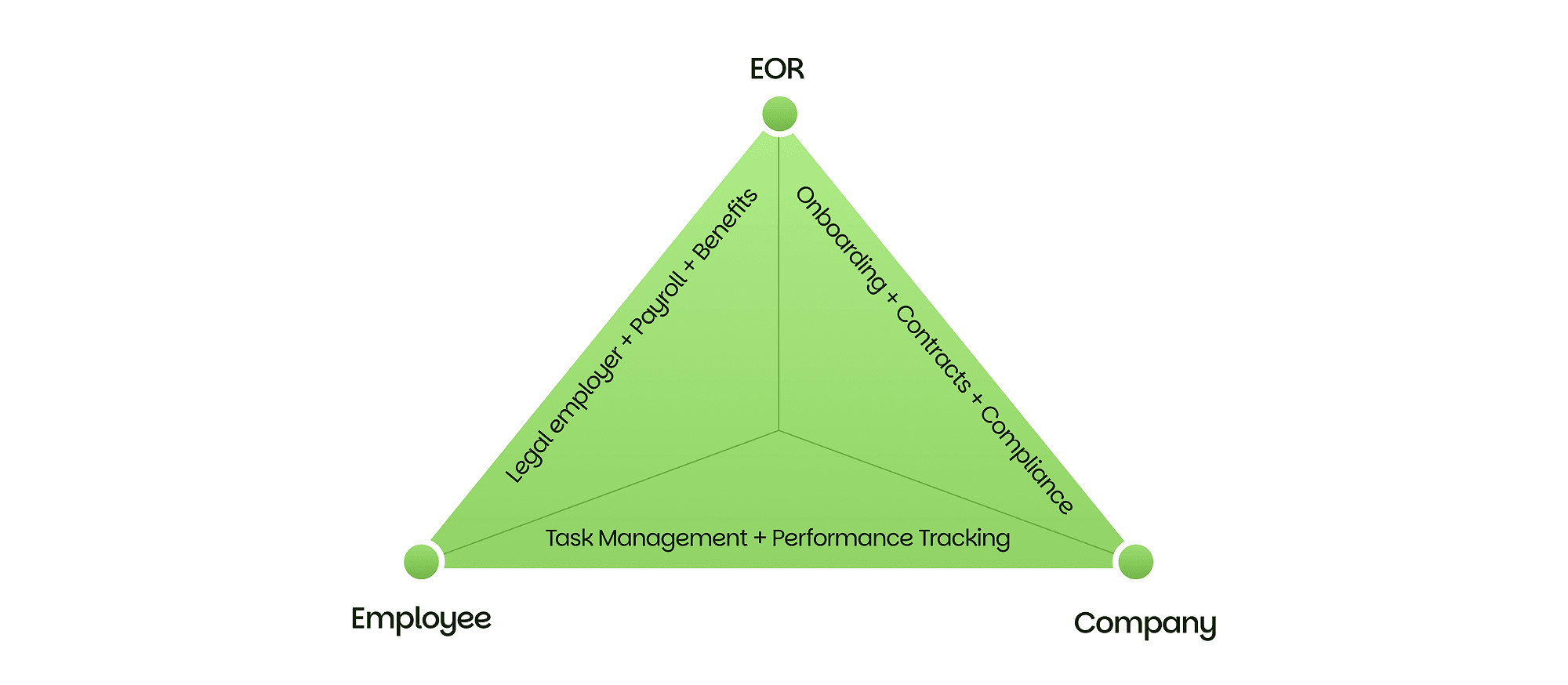
The legal setup plays out like this: you sign a contract with the EOR and the EOR signs a contract with the employee, simple chain. And yes, the contract has to spell it out clearly, the EOR is the legal employer acting on your behalf, you’re the one pulling the strings, they’re the one holding the paperwork.
Think of it like this: The EOR is the legal umbrella. You're the boss. The employee does the work. Everyone stays compliant.
How is this different from hiring contractors?
Contractors are independent workers. They invoice you. They handle their own taxes. They're not legally your employees.
Sounds simple, but it's risky:
Misclassification penalties: Many countries crack down on "contractors" who are actually employees in disguise.
No benefits: Contractors don't get health insurance, paid leave or retirement contributions. This affects retention.
Limited commitment: Contractors can walk away anytime. No long-term stability.
An EOR gives you real employees, legally compliant, with benefits and more committed to your company.
Isn't setting up a legal entity a better option?
It depends on your goals.
If you're planning to establish a long-term physical presence in that country, open offices, build infrastructure, hire locally at scale, then yes, setting up a legal entity makes sense.
But for most companies hiring a small team of employees internationally? It's not the most efficient path. Here's why:
Time Investment: Setting up a legal entity can take 3-6 months, sometime longer depending on the country.
Upfront Costs: A foreign incorporation can range from $10,000-$50,000+ depending on jurisdiction.
Ongoing Compliance: Once the entity is set up, you're responsible for: annual filings and audits, local tax compliance, corporate governance requirements, regulatory updates.
Operational Overhead: Running a legal entity means: opening local bank accounts, managing foreign currency, coordinating with local accountants and lawyers, staying updated on changing regulations.
Exit Complexity: Shutting down a legal entity is almost as complex as setting one up: dissolution fees, final audits, tax clearances. You can't just walk away.
An EOR isn't about cutting corners. It's about choosing the right tool for the stage you're at.
Who should use an EOR?
EORs aren't for everyone. But if you're in one of these categories, they're probably a great fit:
Forward-thinking companies
You see the value in geographic diversification and not putting all your hiring eggs in one regulatory basket.
Startups scaling fast
You need senior talent but can't afford US salaries or the time and cost to set up entities abroad.
Solopreneurs and small teams
You want to hire offshore but don't have the bandwidth to deal with compliance, payroll and HR.
Remote-first companies
Your team is already distributed. An EOR makes it easy to hire anywhere without legal headaches.
If any of these sound like you, an EOR is worth exploring.
How does an Employer of Record work?
Let's break down the process step-by-step.
Hiring and Onboarding
Either you recruit the talent or the EOR does it for you. Once you decide to hire, the EOR steps in with its compliance cover. They draft the employment contract based on local labor laws, handle background checks and get the employee officially onboarded.Payroll Processing
The EOR runs payroll in the employee's local currency. They calculate gross-to-net pay, withhold taxes and ensure compliance with local payroll regulations. You pay the EOR. They pay the employee.Tax and Compliance
Every country has different tax rules, social contributions and employment laws. The EOR handles all of it, filing taxes, submitting reports, staying updated on regulatory changes. You don't have to become an expert in foreign labor law.Benefits Management
The EOR provides legally required benefits, health insurance, pension contributions, paid leave and more. This keeps employees happy and ensures compliance.Ongoing HR Support
Need to update a contract? Handle a termination? Manage a dispute? The EOR handles the HR side, so you don't have to navigate foreign employment law alone.
What is an Employer of Record agreement?
When you engage an EOR, you sign an Employer of Record agreement, the legal document that defines the entire relationship. It specifies who is the legal employer, what the EOR handles (payroll, compliance, benefits, HR), what you handle (day-to-day management, performance), who's liable if something goes wrong, and how payments work. It's not a formality. It's what determines whether you're actually protected or just think you are.
What should be in the agreement
A well-structured EOR contract covers: scope of services, compliance obligations, payment terms, IP ownership, termination rules, and indemnification clauses. The indemnification section is the most important, it tells you whether the EOR absorbs compliance risk or shifts it back to you. IP transfer language matters especially for tech teams: if it doesn't explicitly assign work product to your company, ownership gets murky.
Red flags to watch before you sign
Generic templates used across all countries. Compliance responsibilities buried in footnotes. Vague IP transfer language. Liability clauses that only protect the EOR. These are signs the agreement isn't built around where your team actually sits. Look for country-specific terms, transparent pricing, and clear indemnification that runs in your favor, not just theirs.
Employer of Record benefits
Why are companies choosing EORs over setting up local entities or hiring contractors? Here's why:
Fast market entry
Setting up a legal entity can take months and cost tens of thousands of dollars. According to a survey, it costs more than USD 10k to hire for roles in high-demand fields (Engagedly, 2025). An EOR lets you hire in just a couple of weeks, sometimes days, that too while staying on a budget.
Compliance with local laws
Employment laws vary wildly by country. An EOR ensures you're compliant with contracts, taxes, benefits and labor regulations. No surprises. No penalties.
Reduced administrative burden
Payroll, taxes, benefits, HR paperwork, it's all handled. You focus on running your business, not navigating foreign bureaucracy.
Access to legal employment (not just contractors)
Unlike contractor agreements, an EOR gives employees real employment status. That means benefits, stability and retention. Employees stick around when they're treated like employees, not gig workers.
Cost efficiency
EORs eliminate the need for setting up local entities and the associated costs (Remundo, 2024). With an EOR, you know what you're paying for. No hidden legal fees, no surprise compliance costs. Just a clear monthly rate per employee.
Real-world example
A Philly-based SaaS startup was burning cash trying to hire senior engineers in the US. They switched to an EOR, built a team in South Asia and cut hiring costs by 70%. They're not just surviving now, they're scaling, with a stable team that's been with them for over an year.
Risks and considerations
Nobody’s perfect, so do EORs. Here are some things to watch out for, so you choose the right EOR:
Transparency in pricing
Some EOR providers advertise low fees but tack on extra charges for benefits, onboarding or compliance updates. Ask for a full breakdown. What's included? What costs extra? No surprises.
Country coverage and compliance expertise
Make sure the EOR operates in the countries you're hiring from and has deep compliance knowledge there.
Payroll and benefits capabilities
Can they handle local benefits, taxes and currency conversions smoothly? Check reviews and ask for references.
Customer support quality
When issues arise (and they will), you need responsive support. Test their communication before committing.
Contract flexibility
Some EORs lock you into long-term contracts. Look for flexibility, especially if you're testing a new market.
A good EOR will be upfront about costs, proactive about compliance and easy to work with.
What's the difference between PEO and EOR?
People often confuse EORs with PEOs (Professional Employer Organizations). They're similar but not the same.
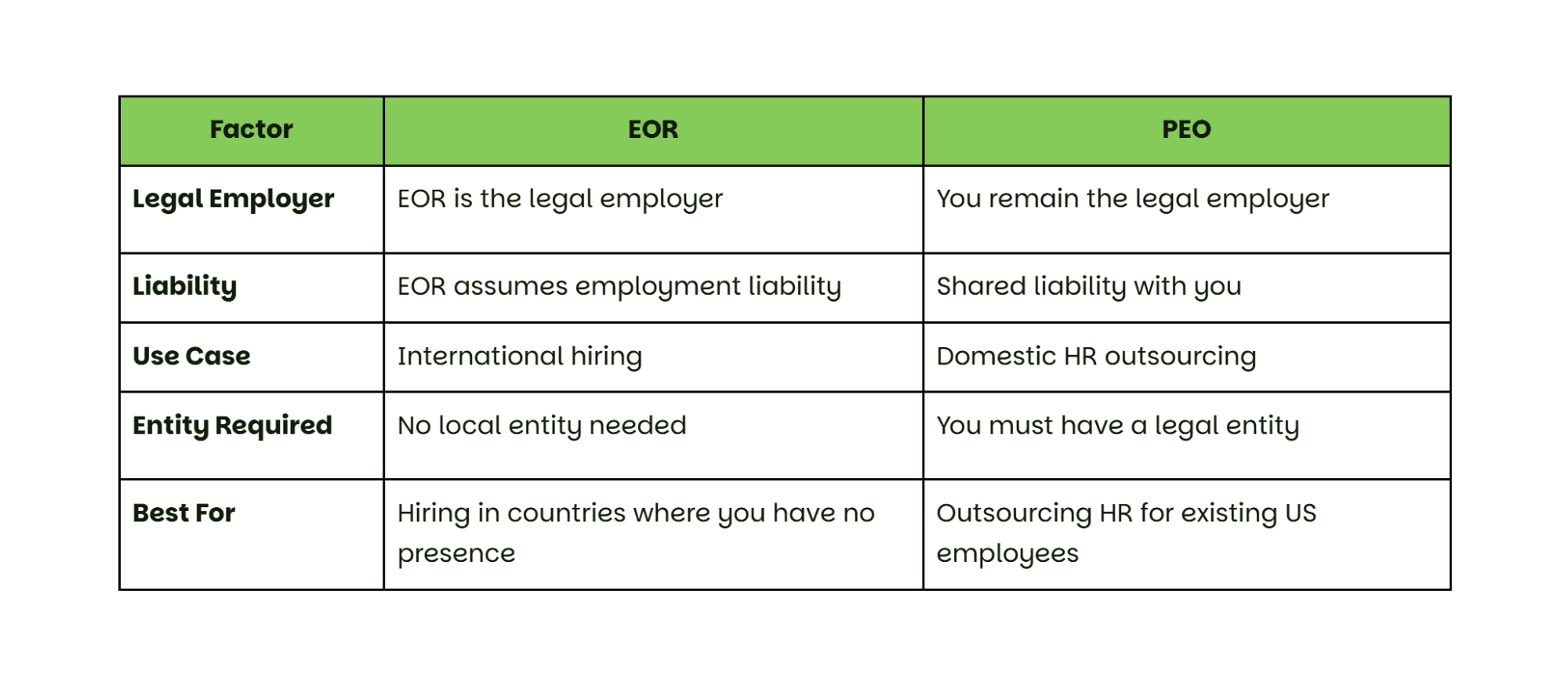
When to use an EOR vs PEO
Use an EOR if you want to hire internationally without setting up a local entity.
Use a PEO if you already have a local entity and want to outsource HR, payroll and benefits within borders.


